

 English
 Français
 Deutsch
 Italiano
 Português
 Русский
 Español
 简体中文
简体中文 日本語
日本語


Unlock the White House Watch newsletter for free
Your guide to what Trump’s second term means for Washington, business and the world
Donald Trump has cast his new peace plan for Ukraine as a make-or-break moment for global diplomacy.
However, even with the fate of the biggest conflict in Europe since the second world war on the line, Washington is trying to earn some money from a settlement.
At the heart of the US-brokered proposal for Russia and Ukraine that is on the table, one financial provision stands out: America will receive 50 per cent of the profits from a venture funded by $100bn in frozen Russian assets for US-led investments to rebuild Ukraine.
“It’s a ‘what’s in it for me’ approach,” said Charles Lichfield, senior fellow at the Geo-Economics Center of the Atlantic Council, a Washington think-tank.
While the measure may or may not make it into any final agreement between Moscow and Kyiv, it highlights a much broader theme in America’s foreign policy during Trump’s second term. With a real estate mogul as US president, and numerous business-savvy special envoys involved in national security, almost all of the White House’s international engagements have a transactional component.
From securing US access to critical minerals in the Democratic Republic of Congo as part of its peace deal with Rwanda, to a 99-year-long US concession for a transit corridor between parts of Azerbaijan across Armenian territory, Trump seems to be constantly scouting for special economic arrangements in exchange for American support.
“Every interaction with the United States entails some element of economic coercion in the form of extraction of non-reciprocal economic benefit,” said one former White House economic official who served under George W Bush.
The provision allowing the US to profit from frozen Russian asset investments in Ukraine comes after Trump has already persuaded Zelenskyy to grant America investment access to its critical minerals sector and other infrastructure projects.
The peace plan, to which Trump has given Zelenskyy until Thursday to agree, dangles in front of Vladimir Putin and his aides a pathway for sanctions on Russia to be removed and additional economic co-operation between Washington and Moscow as rewards for stopping the war.
“I think the quick win for them is that rich Russians come off the sanctions list and can buy hot property in New York City again,” said Lichfield.

Although it has not been unusual for the US to add an economic element to its diplomatic efforts — whether through trade, investment, or regulatory channels — experts say the dealmaking demands of Trump’s second administration echo strategies of a small investment bank or private equity firm more so than a government policy shop. Critics say that the administration’s transactional nature extends to the private sector and domestic affairs as well.
“This idea that the administration has an autonomous economic interest separate from the national interest is new,” said the former senior George W Bush White House official.
Describing what he saw as the second Trump administration’s approach, he added: “‘Do you want your Cfius transaction to be approved? Then we want a golden share. Do you want access to Commerce Department chip [subsidies] money? Then we want an equity stake in your enterprise,’ And . . . ‘are you prepared to contribute to the ballroom?’”
The international aspect of Trump’s shakedowns has been most dramatic. In the case of Ukraine, US officials have insisted that the economic and financial components of the peace deal are crucial because they bolster the US security guarantee for Ukraine by intensifying the economic links between the two countries.

But critics have worried that US economic pressure on Ukraine has been excessive and unnecessary, particularly at the start of the second Trump administration when Washington first floated a critical minerals deal.
Meanwhile, for America to extract profits from Russian frozen asset funds investing in Ukraine reconstruction would be particularly jarring to many European capitals, since the bulk of the frozen assets are held in Europe rather than the US.
Around the world, Trump’s focus on large-scale investment commitments from foreign governments has been nearly obsessive. Tokyo, for instance, had to agree to pump $550bn into the US through a fund whose investments would have to be selected by Trump, to secure 15 per cent tariffs on Japanese exports to the US, and protect its strategic and defence relationship with Washington.
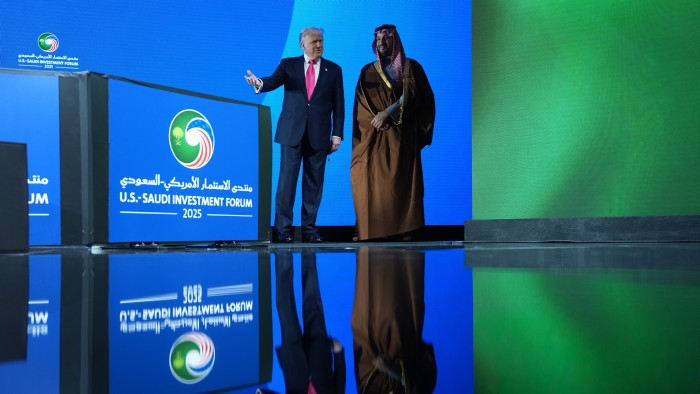
And when Crown Prince Mohammed bin Salman of Saudi Arabia visited Washington this week to agree a new defence pact, he offered to bump his country’s planned investments in the US from $600bn to $1tn. Trump even suggested he should raise it further to $1.5tn.
“Together the United States and Saudi Arabia are unleashing really the most incredible new prosperity together,” Trump said at a Kennedy Center event in Washington with Prince Mohammed on Wednesday. “And we’re also making history and forging peace.”
Read the full article here