

 English
 Français
 Deutsch
 Italiano
 Português
 Русский
 Español
 简体中文
简体中文 日本語
日本語


Investors are snapping up Venezuela’s defaulted debt in a bet that a potential end to Nicolás Maduro’s regime could unlock the once-distant prospect of repayment.
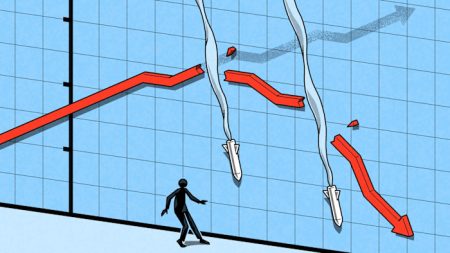
The country’s bonds have rallied in recent days to 33 cents on the dollar, a 40 per cent rise since the start of October, as the Trump administration increases the pressure on the Venezuelan strongman.
That is the highest price since 2019, when US sanctions following the country’s 2017 default prevented creditors from holding restructuring talks with Maduro’s government. Bonds issued by state oil company Petróleos de Venezuela, known as PDVSA, have also rallied strongly.
Some investors believe the price of the Venezuelan bonds still understates the potential pay-off if a US military build-up around the country — which escalated last week with the seizure of an oil tanker — eventually forces out Maduro. A new government, investors hope, could then restructure the bonds and return the country, which has the world’s largest proven oil reserves, to global debt markets after a near-decade absence.
“When people are making that decision to buy Venezuela bonds or PDVSA bonds [at current prices], they are excited about the prospect for regime change,” said Robert Koenigsberger, head of emerging market investor Gramercy Funds Management.
US sanctions led many investors to offload Venezuela’s bonds at rock-bottom prices, far below the implied value of years of unpaid interest. But they have given others a chance to buy into what some longtime bulls are hoping could become the sovereign bond trade of the decade, if the political developments are favourable.
However, analysts point to potential pitfalls. An end to Maduro’s 12-year rule has previously been predicted, only for him to withstand US pressure and stay in power. Meanwhile, a chaotic downfall could trigger civil war instead of IMF-backed reforms and bondholder talks.
María Corina Machado, the Venezuelan opposition leader who won this year’s Nobel Peace Prize, said last week she expected Venezuela’s army to obey orders from a transitional government after Maduro leaves power.
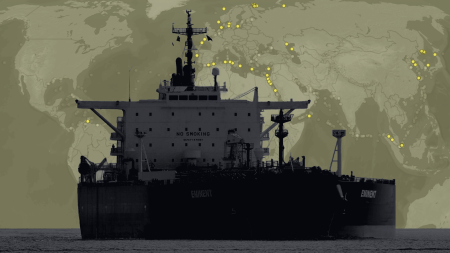
The US seizure of the tanker of Venezuelan crude last week was seen as a signal that PDVSA could soon be unable to get roughly 1mn barrels per day of much depleted production to market, ending a crucial financial lifeline for the elite surrounding Maduro.
“The Americans, by interrupting some of the oil flow, have shown there is now a financial consequence to Maduro staying in power,” said Edward Cowen, chief executive of Winterbrook Capital, a London-based investor that holds about $130mn in Venezuelan assets.
Despite the recent rally, “I don’t think price levels are at a level where they are pricing in a regime change and a restructuring,” he added.
At stake for many investors is years of commitment to one of the few big distressed sovereign debt trades left in markets, after a rally in the bonds of many former outcast governments from Argentina to Zambia.
Other than bonds, some investors such as Gramercy have had legal creditor claims on Venezuela, according to court filings.
Venezuelan bondholders have had to navigate various complexities, including sanctions by the US, which only relaxed restrictions on trading the bonds in 2023, and which recognises Venezuela’s opposition as the overseer of foreign assets such as Citgo, a US refiner owned by PDVSA.
Holders of one specific PDVSA bond are meanwhile close to being paid, after a US court approved a takeover by an Elliott Management affiliate, Amber Energy, of Citgo, a stake in which was collateral for the debt.
Amber has agreed to pay holders of the PDVSA 2020 debt, which is trading at 101 cents on the dollar, about $2bn to give up their claim on half of the refiner. It will have to gain US Treasury approval for the deal first, and then win probable appeals by PDVSA’s opposition-controlled board and other creditors.
“The main determinant of the recovery value of Venezuela bonds is how quickly oil production could be increased,” said Christian Schulz, chief economist, and Alexander Robey, portfolio manager at Allianz Global Investors, earlier this month.
“We think a sovereign debt restructuring would involve an extended negotiation process and a recovery value in the range of 40 to 50 cents in the dollar would be a best-case scenario,” they added.
But some bondholders are hopeful of recoveries of 60 cents or more. That is based on a theoretical 180 cents for the bonds’ face value and unpaid interest, and then applying a discount for a restructuring.
Whatever a deal looks like, investors are also aware of the Trump administration’s penchant for involvement across Latin America, which recently led to a bailout for Argentina.
The shift, codified in a national security strategy as the “Trump corollary” to the traditional Monroe Doctrine policy of opposing intervention by other powers in the western hemisphere, means the US would seek rapid financial backing for a Venezuelan transition, Koenigsberger said.
“This is not simply about a country that is going to come out of a default and have a debt restructuring,” he said. “This is about the Trump corollary to the Monroe Doctrine.”
Read the full article here