


 English
 Français
 Deutsch
 Italiano
 Português
 Русский
 Español
 简体中文
简体中文 日本語
日本語


Introduction
On September 15, RayzeBio (NASDAQ:RYZB) successfully raised $358 million in an initial public offering (IPO) that was upsized in response to strong retail demand. As the shares have sold off over the past week in this turbulent market environment and are now approaching the original $18 per share offer price, it may be a good time to revisit the company and assess its prospects.
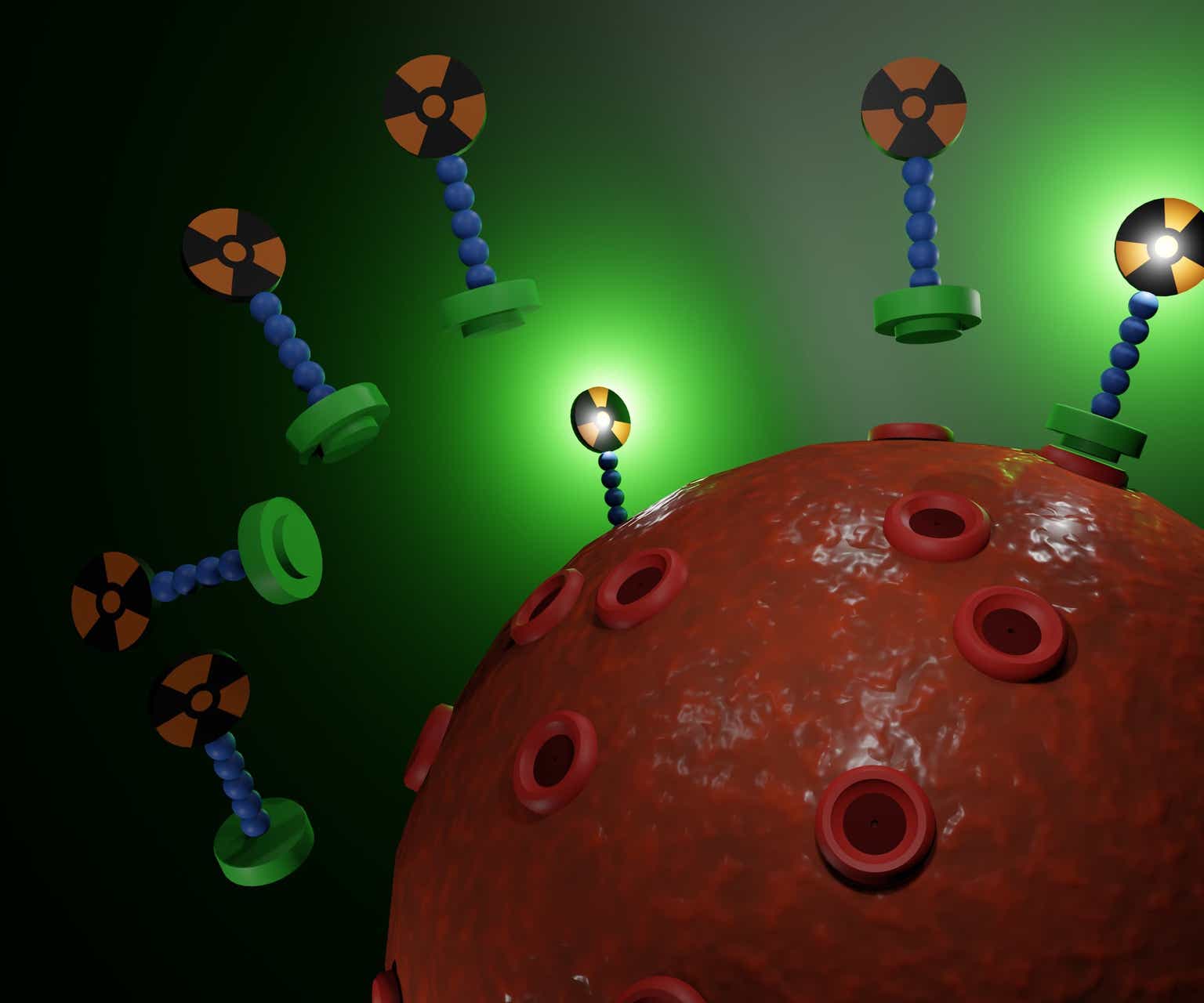
RayzeBio has a promising platform of peptide receptor radionuclide therapy (PRRT) oncology drugs in development for the treatment of solid tumors. PRRTs are a new class of drugs that offer distinct advantages over both external beam therapy (EBT) and antibody-drug conjugate (ADC) treatment. While EBT is generally used to treat localized lesions that can be readily visualized by imaging, PRRT is able to selectively target cancer cells by recognizing and binding to specific overexpressed protein targets, resulting in less off-target toxicity. Compared to ADCs, treatment with PRRTs offers several benefits, including higher potency, deeper and broader tumor distribution, no need for cellular internalization, and avoidance of drug efflux transporter-mediated resistance.
The company’s lead drug candidate, RYZ101, a somatostatin receptor type 2 (SSTR2) therapeutic, is currently being evaluated in a Phase-3 clinical trial compared to investigator-selected standard-of-care (SOC) therapy in patients with gastroenteropancreatic neuroendocrine tumors (GEP-NETs) whose cancer has progressed following treatment with Lutetium 177 (Lu177) beta-particle radioisotope therapy. The primary endpoint for the trial is progression-free survival (PFS).
The company estimates the incidence of GEP-NETs to be approximately 18,000 patients a year in the US with 40-76% of them having metastatic disease at the time of diagnosis while, on an international basis, 23,115 cases were reported in 2020 in the 7MM markets (US, Germany, France, Italy, Spain, the United Kingdom, and Japan), representing a market of just over $2.81 billion. As for the size of the overall patient population, the company estimates it to be as large as 200,000 patients.
The primary treatment option for GEP-NETs is surgical removal. However, as many patients are diagnosed with advanced localized or metastatic disease, this is not an option for many patients. When it comes to drug therapy, the current first-line treatment for metastatic disease is a somatostatin analog (SSA) such as octreotide acetate (brand name: Sandostatin) or lanreotide (brand name: Somatuline Depot). These drugs treat the symptoms of hormonal overproduction and can have a cytostatic effect. Traditionally, the preferred second-line treatment was a mTor inhibitor such as everolimus (brand name: Afinitor) or sunitinib (brand name: Sutent). However, as these medications provide a modest progression-free survival benefit and patients sometimes have tolerability issues, they have been falling out of favor among practitioners and are now frequently replaced by newer peptide receptor radionuclide therapy (PRRT) drugs.
In separate clinical trials involving radiotherapy-naive patients, everolimus and sunitinib had overall response rates (ORRs) of 5% and 9%, respectively. In contrast, in a Phase-3 trial, Novartis’s Lutathera, a recently approved PRRT, demonstrated a significantly higher ORR of 13% and a PFS of 28.4 months. Nevertheless, as most patients relapse after around 28-31 months and continue to survive for up to an additional 40 months and no FDA-approved treatment options are available for patients whose disease progresses further, RayzeBio sees a market opportunity here.
The company’s lead drug, RYZ101, is a PRRT that delivers a highly potent alpha-particle radioisotope to tumors overexpressing SSTR2. The drug consists of DOTA-TATE, an FDA-approved peptide binder, and a chelator bound to the alpha-particle radioisotope. As SSTR2 is expressed in 80-90% of GEP-NET tumors but expressed at much lower levels in healthy tissue, it is an ideal receptor to target. According to the company, alpha-particle radioisotope PRRTs offer several advantages over beta-particle PRRTs such as Lutathera, including the transfer of up to 400 times more radiation energy, less off-target cellular damage from oxygen-free radicals, greater efficacy in hypoxic tumor environments, more effective tumor killing due to double-stranded (versus single-stranded) DNA cleavage, and fewer post-treatment patient restrictions.
Alongside the Phase-3 ACTION-1 trial for the GEP-NETs indication, RYZ101 is also being investigated in a Phase-1b trial as first-line combination therapy with current SOC treatment in patients with Extensive Stage Small Cell Lung Cancer (ES-SCLC) with SSTR2 expressed in at least 50% of their lesions. As lung cancer is the second most common cancer in the US, with an estimated annual incidence of 238,440, and SCLC makes up 14% of these cases, it is a large addressable market.
Finally, the company has a pair of investigational drugs (RYZ801/811 and an unnamed small molecule compound) in the IND-enabling phase for the treatment of hepatocellular carcinoma and renal cell cancer, respectively. As these are still in an early developmental stage, I won’t delve into further detail on them at this point.
The Interim Results of the Phase-3 Trial
RayzeBio recently reported interim results as of June 30, 2023, from the Phase-3 clinical trial based on 17 patients (out of an estimated target number of 31). A partial response (PR), defined as a 30% reduction in the sum of the target lesion diameters, was confirmed in 5 of 17 patients, representing an overall response rate (ORR) of 29%. The company moreover indicated that the treatment was well tolerated with no treatment-related serious adverse events (SAEs) or adverse event-related dose discontinuations.
While this ORR sounds impressive, comparing the results to Lutathera is like comparing apples to oranges due to the differences in study design between the two trials (the Lutathera NETTER-2 trial involved first-line use in combination with long-acting octreotide while RYZ101 was administered as a monotherapy to patients whose cancer had progressed after treatment with Lutathera). Nevertheless, as both the NETTER-2 and ACTION-1 study populations consisted of patients with advanced GEP-NETs and the RYZ101 patients had already failed prior therapy with Lutathera, an ORR of 29% seems promising at first glance. However, as the study is not expected to be completed until the end of 2026 and we still don’t know what the PFS (primary endpoint) will look like or how the drug’s efficacy and safety profile will compare to the SOC treatments, we’re still in the very early innings.
RayzeBio reported the following Grade 3 or higher adverse events in the interim read-out: decreased lymphocyte count (17.6%), anemia (17.6%), decreased creatinine clearance [a potential indicator of kidney damage] (11.8%), and weight loss (5.8%). No treatment-related SAEs were reported. This compares favorably to Lutathera, where the following Grade 3 or higher adverse events were reported: lymphopenia (44%), elevated GGT (20%), AST (5%), and ALT (4%) [potential indicators of liver damage], vomiting (7%), nausea (5%), hyperglycemia (4%), and hypokalemia (4%) along with several less common, but potentially life-threatening SAEs, such as MDS (2%), renal failure (2%), cardiac failure (2%), acute leukemia (1%), hypotension (1%), myocardial infarction (1%), and neuroendocrine hormonal crisis (1%).
Assigning a Value to the Portfolio
There are numerous ways to assign a value to a biotech company’s drug portfolio. Perhaps the most common methods are net present value or risk-adjusted net present value, which models a company’s future cash flows, and competitor analysis, where a market value is calculated on the basis of the amount paid for companies in an equivalent developmental stage with similar products. As I firmly believe that the more variables you introduce into an analysis, the higher the chance that you’ll get it wrong, I’m going to keep it simple and base my assessment on just one variable: peak sales.
For RYZ101, RayzeBio estimates that the addressable patient population consists of approximately 7,000 patients undergoing prior treatment with Lutathera. As several companies are currently developing targeted alpha-based PRRTs for the treatment of cancer, including Bayer (OTCPK:BAYRY), Novartis (NVS), Johnson & Johnson (JNJ), Abdera Therapeutics, Actinium Pharmaceuticals (ATNM), Aktis Oncology, Convergent Therapeutics, Debiopharm, Fusion Pharmaceuticals (FUSN), ITM Isotope Technologies Munich SE, Lantheus Holdings (LNTH), Mariana Oncology, Perspective Therapeutics (CATX), POINT Biopharma (PNT), RadioMedix, Telix Pharmaceuticals (OTCPK:TLPPF), and Y-mAbs Therapeutics (YMAB), I think it would be optimistic to assume that they could capture more than 50% of this population (i.e., 3,500 patients).
While the price/treatment of Lutathera is currently around $230,000, due to the later line of treatment, improved potency, and easier drug handling, the company believes that it will be able to charge a premium price for RYZ101. If we throw a dart (since the company has not indicated exactly what they will price the drug at) and assume a 50% premium, it gives us a price/treatment of $345,000. Multiply that by a peak population of 3,500 patients and we arrive at peak sales of about $1.2 billion. This seems a little high considering that most peak sales estimates for Lutathera range from around $650 million to over $800 million. However, the Lutathera estimates are solely based on the approved mid-gut indication. Expansion into other types of GEP-NETs has been estimated to increase the potential patient population threefold.
For the net present value calculation, I’ve made the following assumptions:
-
FDA approval in 2030 (approx. 2 years after completion of the Phase-3 trial)
-
Peak sales reached in 2036 (based on the average of 5-7 years after approval for oncology drugs)
-
Discount rate applied: the current 10-year US treasury bond rate (4.54%)
-
Risk-adjusted approval factor (based on the clinical success rates for oncology drugs): Phase 3: 35.5%; Phase 2: 6.7%; Phase 1: 3.4%
This gives us a present value of $673.8 million for RYZ101. Applying the risk-based discount factor to account for the likelihood of approval, we arrive at a present value of $239.2 million for the peak sales of RYZ101 for the GEP-NET indication. However, as several PRRT drugs, such as Pluvicto and Lutathera are already on the market and the FDA has already approved the use of RYZ101’s peptide binder, DOTA-TATE, for SSTR2 diagnostic imaging and therapeutic agents, the drug has been de-risked to a certain extent. Therefore, I believe that the overall success rate for Phase-3 trials (59%) is a more suitable risk-adjusted approval factor. This results in a risk-adjusted present value of $397.5 million for the peak sales.
As RYZ101 is also involved in a Phase-1 trial for first-line use in ES-SCLC, it is also included in the net present value computation. However, as I can’t find any guidance from the company estimating the size of the targeted patient population or price per treatment, it is impossible to accurately predict what the peak sales might look like once the drug is eventually approved for this indication. As RayzeBio indicates in the S-1/A that 33,400 new cases of SCLC are diagnosed each year, where 66% of the patients have metastatic disease and approximately 50% express SSTR2, we can arrive at an estimated patient population in the US of around 22,000 patients annually (the addressable population would naturally be larger if we include other 7MM countries).
The peak sales of Roche’s Tecentriq have been estimated at $2.8 billion, including a modest amount of sales from second-line use, while its cost per treatment is just over $160,000. If we make the assumption that RYZ101 would be priced equivalently and assume a patient population of just 11,000 (50% of US patients) in the year in which peak sales are reached, we arrive at a figure of $1.76 billion (this is probably on the conservative side as it ignores sales in international markets).
Assuming that peak sales are reached in 2039 and applying the rest of the assumptions listed above, we obtain a net present value of $865.0 million for peak RYZ101 sales from the ES-SCLC indication. Applying the risk-adjusted approval factor for Phase-1 drugs gives us a risk-adjusted present value of $29.4 million. Once again, however, since the drug has been somewhat de-risked, I think it is more appropriate to apply the overall success rate for Phase-1 drugs (13.8% versus 3.4% for oncology drugs), which then gives us a risk-adjusted net present value of $119.4 million.
Since the rest of the company’s drug portfolio has yet to advance into the clinic, I am not assigning any value to these drugs.
If we err on the side of caution and apply the more conservative estimates, the net present values for the peak sales of both drugs add up to $268.6 million. Otherwise, if we assume that the drugs have been de-risked enough to merit the higher risk-adjusted approval factors, we arrive at a considerably higher overall net present value figure ($516.9 million).
Dividing the company’s current market cap ($1.144 billion as of Sep. 25) by the more conservative risk-adjusted approval factors results in a Price/Sales multiple of 4.26 compared to the industry average for biotech companies of 5.78. If we instead focus on the company’s current enterprise value ($945.7 million as of Sep. 25), we arrive at an EV/Revenue multiple of 3.52 compared to the industry average of 6.18. Using the less conservative figures yields even more attractive multiples: 2.21 (P/S) and 1.83 (EV/Revenue).
Upcoming Catalysts
The most immediate upcoming catalysts on the horizon are the ratings that will pour in from investment analysts once the quiet period expires on October 25. Aside from this, there are several potential catalysts next year, including updated Phase-1b data from the RYZ101 ACTION-1 trial, IND submission for RYZ801/811, human imaging results for the company’s small-molecule CA9 drug, initial Phase-1b data from the RYZ101 ES-SCLC indication, and the commencement of compassionate-use treatment for RYZ801/811 in hepatocellular carcinoma patients.
The Bull Case
Due to their improved potency, deeper, broader tumor distribution, and better avoidance of drug resistance mechanisms, PRRTs have the potential to be a game changer, replacing ADCs as the treatment of choice for many solid tumors. FDA-approved alpha- and beta-based PRRT drugs such as Xofiga, Pluvicto, and Lutathera all boast projected peak sales that approach or exceed $1 billion while the US TAM for the GET-NETs indication RayzeBio is targeting has been estimated at around $800 million. Alpha-based radioisotope PRRTs such as RYZ101 offer several important benefits over beta-based ones like Lutathera, including more potent radiation energy transfer, more efficient cancer cell killing, and fewer post-surgical patient restrictions. Moreover, there is additional optionality in RayzeBio’s pipeline if the company is successful at identifying additional solid tumor cancers, such as ES-SCLC, where the SSTR2 receptor is expressed.
With successful healthcare hedge fund backers such as VenBio and Viking Global, an experienced management team, and a cash runway through 2025 (per the company’s statement in the S-1/A), at the current price, I feel that RayzeBio makes a compelling investment case with a number of shots on goal.
The Bear Case
As with all development-stage biotechs, there are numerous risks involved with any investment. There is a long list of competitors with alpha- and beta-based PRRTs currently undergoing clinical trials, some of whom have far greater resources than RayzeBio. Moreover, the company’s success in obtaining FDA approval for their drug candidates will depend on their ability to raise capital to fund the clinical trials as well as the efficacy and safety profile of their drugs in comparison to other treatment options. In addition, as an emerging growth company, as defined in the JOBS Act, the company is exempt from certain public reporting requirements. Finally, as a vertically integrated company, manufacturing missteps may occur, such as failure to obtain cGMP certification, which could result in the delayed approval or rejection of the company’s drug candidates.
Overall Rating
Overall, I think that the stock is a good value at this level and am very enthusiastic about the potential for alpha-based PRRTs to shift the paradigm when it comes to the treatment of advanced solid tumors. With a product in advanced Phase-3 testing and a promising drug pipeline with optionality for other solid tumor applications, I rate RayzeBio as a speculative Long-term Buy.
As far as the timing goes, without the privilege of a crystal ball, I would probably accumulate shares either right before the end of the quiet period (October 25) or around the time that the 180-day lock-up period expires.
Rating (on a scale of 1-5, where 1 pepper is a supreme fail and 5 peppers is a smashing hit)
rawpixel.com
Read the full article here