

 English
 Français
 Deutsch
 Italiano
 Português
 Русский
 Español
 简体中文
简体中文 日本語
日本語

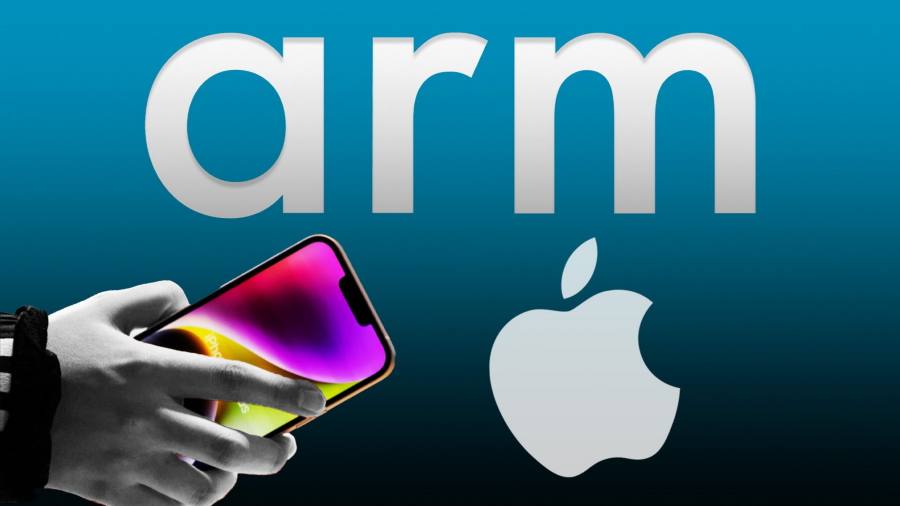

Few companies preparing for a blockbuster stock market debut can claim a 99 per cent market share at the heart of the world’s most lucrative and ubiquitous consumer product.
But for Arm, the SoftBank-owned chip designer, its overwhelming dominance of smartphone processors is both its biggest asset and the greatest challenge to achieving a putative $60bn-plus valuation in next month’s initial public offering.
Arm’s “substantial existing market share” in the mobile and consumer electronics markets “may limit opportunities for future growth”, the company warned in its IPO prospectus published this week.
While other markets, such as automotive chips and processors for cloud computing, hold promise for Arm, analysts say it can never hope to recreate its near-monopoly in mobile.
At the same time, Arm is largely excluded from the hottest corner of the semiconductor market this year: creating chips for processing vast artificial intelligence models such as OpenAI’s GPT 4, a market dominated by Nvidia.
“It’s hard to see that Arm is going to see any significant growth in [mobile] beyond where they are today,” said Geoff Blaber, chief executive at CCS Insight, a tech research group. “Nothing is going to be as large as the iPhone, so Arm is a bit of a victim of its own success, in the same way that Apple is.”
The Apple conundrum
Arm and Apple’s fortunes have been intertwined for three decades. The UK chip designer was founded in 1990 as a joint venture between Apple and Acorn Computers, a British PC maker, alongside Silicon Valley-based chip manufacturer VLSI.
The Cambridge-based start-up had pioneered a novel kind of chip architecture that prioritised speed and simplicity over raw processing power. Its blueprints for low-power chips proved ideal for battery-powered mobile phones, first in the Nokia era, and then when the iPhone ignited an even bigger wave of growth starting in 2007.
Even though Apple helped finance its creation, Arm’s relationship with the iPhone maker today is complicated.
Despite being one of the most successful developers of Arm-based chips, Apple receives only a couple of passing references in Arm’s IPO filing and the iPhone is mentioned just once.
Arm has several models for licensing its technology. At one extreme is unlimited access to its entire portfolio of intellectual property under what it calls “Total Access Agreements”.
At the other is a much more narrow architecture licence, giving customers the basic building blocks they need to develop highly customised chips but typically yielding lower revenues for Arm. Apple holds a longstanding architecture licence, pouring billions of dollars into developing its breakthrough Arm-based processors for iPhones and now Macs.
“The thing that shot Arm in the foot is they gave away some sweetheart deals,” said Dylan Patel, chief analyst at SemiAnalysis, a consulting firm.
Arm argues that it can grow by selling more technology into each smartphone. The company extracts only a “small share from the value it contributes”, said Jay Goldberg, founder of chip consultancy D2D Advisory, in a research note on Tuesday. He pointed to Arm’s 2.7 per cent royalty rate from the 30bn Arm-powered chips that its customers shopped in the last fiscal year, or $0.11 per chip.
Deals like the one it has with Apple, and the smartphone industry’s concentration on a handful of big handset makers, limit Arm’s pricing power despite the lack of alternatives to its technology, Patel said.
Those customers are not going anywhere. Arm estimates that 46 per cent of its royalty revenue for the last fiscal year came from products it released between 1990 to 2012, showing the underlying endurance of its business model. But that may not be enough to entice investors to value a business that had revenues fall 1 per cent to $2.7bn last year at more than $60bn.
“They’ve got to go into new markets,” said Malcolm Penn, chief executive of Future Horizons, a chip consultancy. “They are not in the same position as they were back in mobile. It’s not as easy a run as it was back then because there isn’t one major end customer driving it.”
A future beyond smartphones
When SoftBank in 2016 bought Arm, until then a public company listed in London and New York, the Japanese group’s chief executive Masayoshi Son declared it would propel the company to the heart of the “internet of things”.
Seven years later, analysts say that initiative failed to produce the desired new growth. Arm’s prospectus says it has a 65 per cent share of the market for industrial IoT and embedded semiconductors, but the small and lower-value nature of products in that area have made it less lucrative than Son envisaged.
The billionaire investor’s latest obsession is AI, where Arm is making some headway. It works with self-driving car companies such as GM’s Cruise. Nvidia uses an Arm CPU in its Grace Hopper “super chip”, used for processing AI models in data centres.
But instead of sitting at the centre of these devices, Arm’s technology is in more of a supporting role to more powerful chips such as Nvidia’s H100 when it comes to AI.
Nonetheless, Arm stands to be a beneficiary of a wider shift in how data centres are designed around AI workloads, Patel said. Cloud computing companies Amazon, Google and Microsoft are all working on Arm-based CPUs for their data centres.
Arm estimates it has a 10 per cent share of the $18bn market for cloud processors, up from 7 per cent in 2020, and the sector is predicted to grow by a double-digit percentage over the next few years.
Another key growth area is the automotive market, as carmakers keep on increasing the computing power within their vehicles, from engine management to assisted-driving technology. Arm claims a 41 per cent share of the automotive market and its royalty revenue grew by 36 per cent last year.
However, in a $200bn total addressable market of “all chips that can contain a processor”, Arm estimates that it has captured almost half of its potential. After conquering the mobile market, Arm may find the second $100bn is the hardest.
Read the full article here