

 English
 Français
 Deutsch
 Italiano
 Português
 Русский
 Español
 简体中文
简体中文 日本語
日本語


Unlock the White House Watch newsletter for free
Your guide to what Trump’s second term means for Washington, business and the world
A former top Chevron executive is raising $2bn for Venezuelan oil projects as investors race to answer Donald Trump’s call to pour “billions of dollars” into the country after the US toppled its president Nicolás Maduro.
Ali Moshiri, Chevron’s former head of Latin American operations, told the Financial Times his Amos Global Energy Management fund had identified multiple Venezuelan assets and was talking to institutional investors about a private placement to kick-start investment.
US special forces’ capture of Maduro on Saturday and Trump’s call for US companies to revive Venezuela’s oil industry had created a sudden opportunity, Moshiri said.
“We have been anticipating this breakthrough for a while and our $2bn private placement memorandum is ready to go with several investment targets identified,” he said in an interview.
“I’ve had a dozen calls over the past 24 hours from potential investors. Interest in Venezuela has gone from zero to 99 per cent.”
The US assault on Caracas and Trump’s warning that Washington would dictate terms to Venezuela’s new leaders has raised the prospect of a corporate rush into a country boasting the world’s largest oil reserves.
It marks a potential new era for the companies. The last major opening of a country’s reserves was in 2009 in Iraq, where auctions for oilfields drew multibillion-dollar bids six years after the US invasion.
But the three US oil majors have cautiously greeted Trump’s call for investment due to concerns about political instability, a history of expropriated assets in Venezuela and the vast sums required to boost production.
One industry insider said the chief executives of ExxonMobil, Chevron and ConocoPhillips were blindsided by the US military action.
“None of the industry players that have the capital and the expertise to invest in Venezuela were advised or consulted prior to either the removal of Maduro or the president making his statements yesterday,” said the insider.
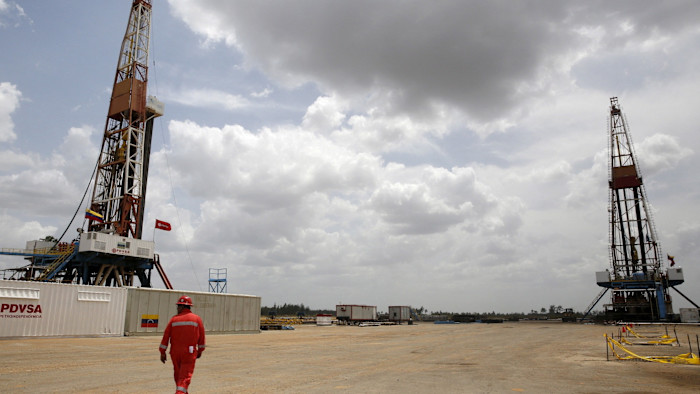
Amos’s fundraising effort will mark an early test of Wall Street’s appetite to bankroll the rebuilding of Venezuela’s decrepit oil infrastructure, which has been degraded after years of mismanagement and sanctions.
The memorandum for investors prepared by Amos, which has been seen by the FT, is dated December 2025. It shows the fund intends to acquire 20,000-50,000 barrels a day of oil production and 500,000 barrels of reserves from the state oil company Petróleos de Venezuela (PDVSA). It anticipates an exit within five to seven years and a return on investment of two and a half times.
Other private investors have also signalled their potential interest in Venezuela following the US intervention.
Harold Hamm, the US shale tycoon and a prominent donor to Trump, told the FT his company Continental Resources would consider investing in Venezuela under the right circumstances.
“While we do not have any immediate plans with respect to Venezuela, we believe the country has significant resource potential and with improved regulatory and governmental stability we would definitely consider future investment,” he said.
While private investors are expected to move quickest in heeding Trump’s call, industry analysts said only US majors would have the heft and expertise to rebuild the nation’s vast and complex heavy oil sector.
Chevron, which is already operating in the country under a special licence provided by the Trump administration, is considered the best placed producer to step up investments. But it said it was focused on employee safety and integrity of its assets.
Its rival ExxonMobil has not responded to requests for comment about its intentions in Venezuela. It is still seeking payment of a $1.6bn arbitration award linked to the expropriation of assets almost two decades ago by Hugo Chávez, Maduro’s predecessor.
ConocoPhillips, which won an $8.4bn arbitration award over the expropriation of its Venezuelan assets, said it would continue efforts to collect its award and it was “premature” to speculate on future activities.
While Trump was explicit in calling for US companies to invest, his secretary of state Marco Rubio left the door open to producers from allied countries — but not those from America’s adversaries.
China is Venezuela’s biggest oil customer and its companies, as well as Russian companies, have been investors in its upstream.
“What we’re not going to allow is for the oil industry in Venezuela to be controlled by adversaries of the United States,” he told NBC News’ Meet the Press. “Why does China need their oil, why does Russia need their oil, why does Iran need their oil? . . . This is the western hemisphere, this is where we live.”
Some European companies with operations in Venezuela — Spain’s Repsol and Italy’s Eni — could invest if US sanctions were lifted, said analysts. But they would wait to see whether the fiscal terms for non-US companies were favourable.
Moshiri has attempted to buy Venezuelan assets in the past. In 2022 he signed a joint venture with Gramercy Funds Management to invest in the offshore Gulf of Paria. Amos later agreed to buy some Venezuelan oil and gas assets owned by China’s Sinopec.
Moshiri said the deals fell through because the investment fund was not able to obtain a licence from the Biden administration.
“Now with Trump administration, which is more commercially friendly and economically driven, we are starting a new fund and are very confident.”
Read the full article here