


 English
 Français
 Deutsch
 Italiano
 Português
 Русский
 Español
 简体中文
简体中文 日本語
日本語


Unlock the Editor’s Digest for free
Roula Khalaf, Editor of the FT, selects her favourite stories in this weekly newsletter.
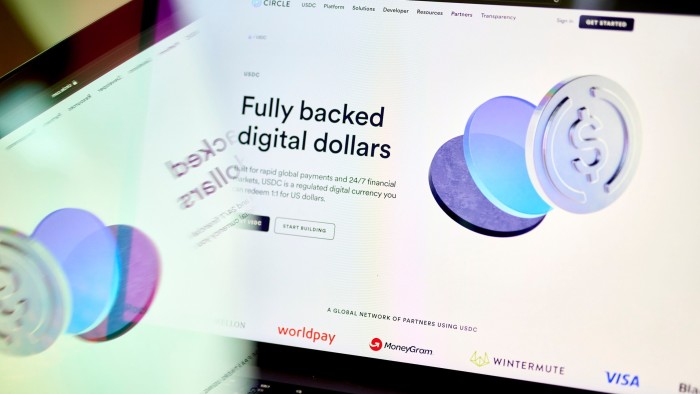
Circle, the world’s second-biggest issuer of stablecoins, is examining ways to make it possible to reverse transactions involving its tokens, in a rare admission by a major crypto firm that it needs to take lessons from the traditional financial sector.
Circle president Heath Tarbert said a mechanism that allowed money to be refunded in cases of fraud or disputes would help the stablecoin industry’s push to become part of the financial mainstream.
“We are thinking through . . . whether or not there’s the possibility of reversibility of transactions, right, but at the same time, we want settlement finality,” Tarbert told the Financial Times.
“So there’s an inherent tension there between being able to transfer something immediately, but having it be irrevocable,” he added.
Such measures would be a major departure from the crypto industry’s previous emphasis on the “immutability” of the blockchain, a digital ledger that is public and records transactions that cannot be unwound.
They also mark a dramatic change in attitude in an industry that has often tried to distance itself from so-called “tradfi”, and will be seen by some crypto purists as tantamount to heresy. One prominent venture capitalist said it was “offensive” to still call Circle’s planned venture a blockchain.
Tarbert, a former chair of digital assets regulator the US Commodity Futures Trading Commission, said there were discussions taking place among software developers “as to whether on certain blockchains for certain circumstances, provided all the parties agree, there could be some degree of reversibility for fraud”.
He added: “People say blockchain technology, stablecoins, smart contracts, are superior in technology to the current system. But there are some benefits of the current system that aren’t necessarily currently present.”
Tarbert’s comments come several months after the Trump administration killed off a proposal by the US consumer banking regulator to make cryptocurrency companies responsible for refunding customers’ accounts when they are hacked, bringing standards for digital wallets into line with bank accounts.
The US has been laying the groundwork for a potential surge in the use of stablecoins, as banks and credit card companies explore blockchain technology. The tokens act as a form of digital cash, pegged to sovereign currencies such as the US dollar, making them far less volatile than cryptocurrencies such as bitcoin, and can make payments outside the traditional banking system.
They play a central role in digital asset markets but financial services firms see the technology as a potential pathway for faster, cheaper cross-border payments. There are roughly $280bn of stablecoins in circulation and the Trump administration has strongly backed their development in the hope it will extend the reach of the US dollar into new markets. Congress in July passed a landmark bill to regulate the sector.
Circle, which currently has $74bn of USDC in circulation, has begun testing a new blockchain, called Arc, intended for use by financial institutions, in which companies, banks and asset managers could use stablecoins to make payments in foreign exchange deals.
However, some executives and developers have criticised Arc for being too centralised and contrary to one of the original goals of blockchain technology, which was to bypass intermediaries such as banks.
Circle said payments could not be directly unwound on its Arc blockchain but instead it could add another layer in which parties could agree to make counter-payments, akin to refunds on a credit card.
Its courtship of banks and big institutional investors is in marked contrast to that of Tether, which built its dominant position as the world’s biggest stablecoin issuer by focusing on high-volume crypto trading and offering itself as an alternative to the dollar in emerging markets.
Circle is also looking at offering users the ability to select transparency on the size of balances and transactions to shield sensitive financial information. While customers’ anonymous wallet addresses would remain visible on its blockchain, Arc would encrypt the value of the transfer.
“If you’re a financial institution or working with clients and you’re sending money around you don’t necessarily want . . . for the world to see every transaction so we created a confidentiality layer to shield the amount,” he added.
In August, Goldman Sachs said the sector was only at the start of a “stablecoin gold rush”, in which Circle’s USDC could grow by $77bn by 2027, or a compounded annual growth rate of 40 per cent for three years.
Tarbert said it was unclear where the flows will come from, but played down banks’ fears that they could come from long-term bank deposits.
While it is “possible” that people could take money out of their current accounts and put it into a stablecoin, “it’s [also] entirely possible people could move out of other asset classes into stablecoins and it’s entirely possible that new wealth could be created,” he said.
Read the full article here