

 English
 Français
 Deutsch
 Italiano
 Português
 Русский
 Español
 简体中文
简体中文 日本語
日本語


Unlock the White House Watch newsletter for free
Your guide to what Trump’s second term means for Washington, business and the world
Anger in America gave us President Donald Trump. Now, EU leaders’ response to him is giving us anger in Europe. Instead they should see it as an opportunity.
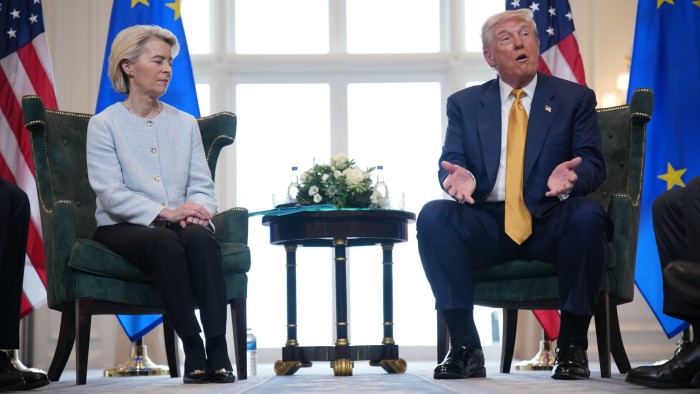
The popular verdict on Ursula von der Leyen’s trade “deal” with Trump is in, and it’s not pretty. In a recent poll of residents in the EU’s five most populous countries for the French journal Le Grand Continent, more than half called it a “humiliation”.
Three-quarters said it mainly benefited the US; the same share said von der Leyen had defended European interests poorly. Nearly half consider Trump an “enemy of Europe” (only 10 per cent think he is a friend). Three-quarters are dissatisfied with the position the EU is taking towards Trump.
It’s not just voters who are fuming. Expert opinion, too, has been harsh, with calls to resist the US’s “extractive” behaviour and for “the gloves to come off” in digital policy. Mario Draghi himself, the closest Brussels has to an oracle, slammed the EU’s plodding response to intensified geoeconomic rivalry as “complacency” in a speech this week. Discontent is even seeping out from the commission’s technocrats, with trade chief Sabine Weyand stating publicly that there was no negotiation, only a decision to submit to Trump’s demands.
So has von der Leyen lost the Europeans? Some would deny that the EU ever had much support. But those tend to be the same people who predicted that Brexit would set off a wave of copycat movements across Europe; now even the UK has consistent pro-European majorities.
It’s clear that Europeans are angry at the current EU leadership (a large majority would favour von der Leyen’s resignation and express lack of confidence in her). But there is still support for staying in the EU (unless — for a narrow plurality of French and Polish people — it fails to protect them from geopolitical threats). The commission president’s State of the Union address on September 10, in which she came across as more robust than earlier, was presumably a response to all this.
A fair retort to all this is: “What was the alternative?” But alternatives did exist. There was the option of retaliation (“taking the gloves off”) in the form of tougher action on US Big Tech; or of doing nothing, paying the cost of US protectionism but not endorsing it as a mutual agreement. Even if one accepts that a “deal” was the lesser evil, the political task was to make this a “never again” moment.
The sin was the pretence that things are better than they are. At the start, EU leaders defended the deal as not so bad and procuring valuable stability. Soon some of them were discreetly letting on that the Europeans had accepted a bad deal lest Trump pull the plug on weapons and intelligence for Ukraine. Draghi subtly exposed the weakness of that excuse: if the EU is forced to do damaging things because of its dependence on the US (or China), why is it not doing whatever it takes to diminish that dependence?
What isn’t being said clearly enough is that Europe is doing what it is doing under duress. When America extorts European obeisance, America is no longer Europe’s friend.
That is plainly a profound — perhaps existential — crisis for Europe. Yet EU and national leaders in Europe are not admitting this obvious fact, strangely for a political project “that will be forged in crises” as one of its founders had it.
Holding on rhetorically and politically to a normalising “pragmatism” in the face of Trump’s abnormal attempts at domination is weakening Europe’s ability to resist. If you do not protest today, it becomes ever harder to protest in future.
So what could be done differently? First, admit that Europe was forced to accept humiliating terms but that it is now imperative to build up the strength to resist. Then, be honest that a former friend might now inflict economic costs that Europeans will have to bear — and that the response requires solidarity and sacrifice, including actively seeking European alternatives to US goods and services. Be unflinching that old taboos against doing things in common must be shed, because the choice is to hang together or to hang separately.
These are messages, not policies. Yet the signs are that if Europeans heard such messages, they would welcome bolder policies, even dare greater confrontation with the US. In the poll, 39 per cent said “opposition” should be the EU’s response to Trump (half said “compromise”, only 11 per cent “alignment”). Brutal honesty with the public would make it clear that too many leaders are dragging their feet. That may be why we are not getting it yet.
Read the full article here